Quote

This should be shared with HIV/AIDS Country Directors across the region:

On behalf of the UNAIDS Inter-Agency Task Team (IATT) on HIV and Young People, FHI 360 is putting out a call for programs or interventions that illustrate best practices in HIV interventions for young people. Submissions will be assessed by a team of experts. Those that most compellingly illustrate best practices will be included as case studies in a publication and disseminated globally. Submitted programs or interventions should either align with at least one of the six themes of the IATT Global Guidance Briefs (61 pages, 2.5 MB), or specifically target young people living with HIV, or adolescent girls. The deadline for submission is October 17, 2011.

To submit a program or intervention for consideration, please click here and submit the form by October 17, 2011. They will be evaluated based on predetermined criteria to ensure that the most comprehensive and appropriate programs are highlighted. Please be sure to include complete contact information as additional information may be requested. If you have any trouble filling out the form, please contact youthwg@fhi360.org.

Quote


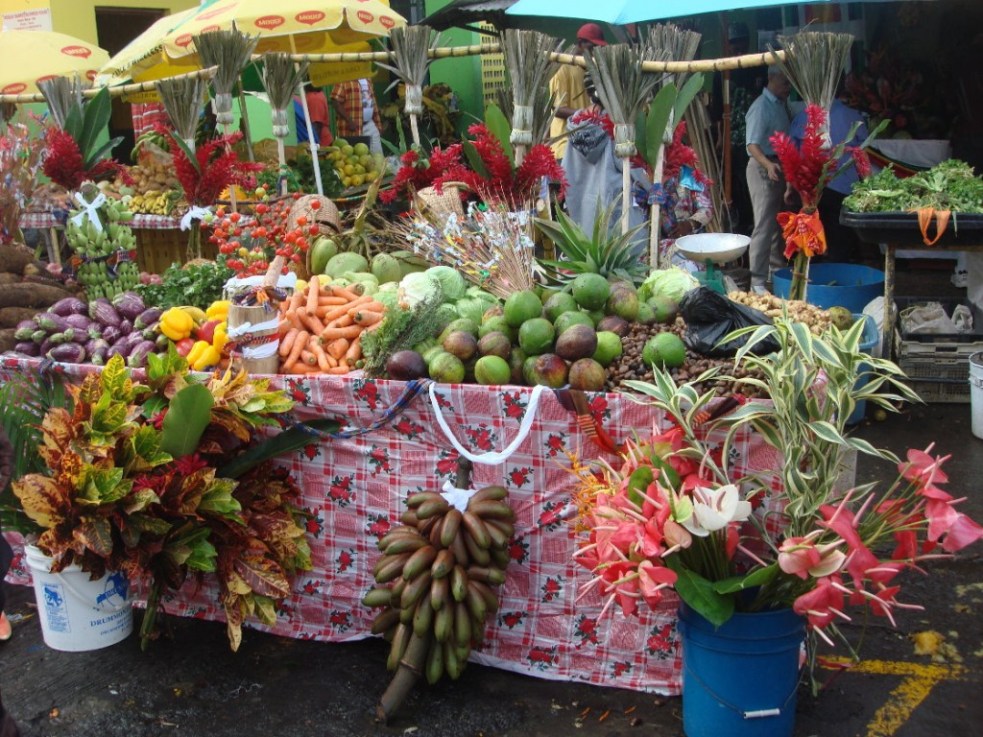
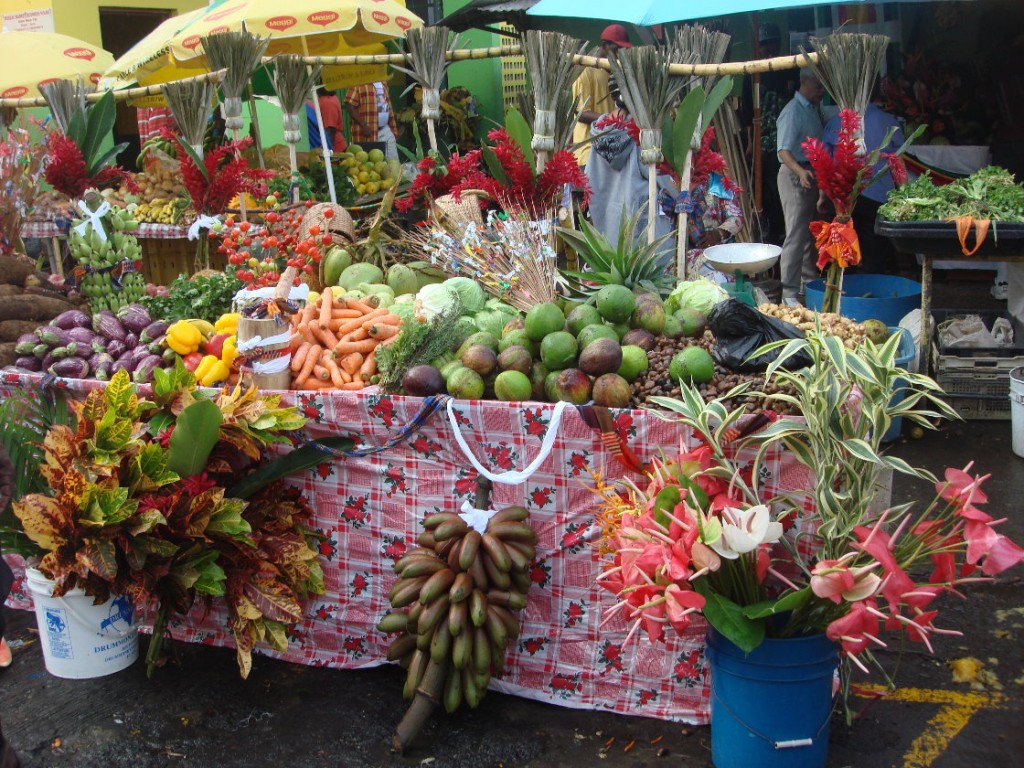
A saw this picture a few weeks ago on Dominica News Online, and it immediately brought back memories of going to Saturday markets with my grandma. It also reminded me of Dominica’s annual Market Day with a Difference, which occurs around Independence celebrations.

We as a region have amazing bounties, and we really need to get back to basics when it comes to what and how we eat. In the past 10 to 15 years, there has been a quiet revolution across the region with the introduction of more packaged goods than ever before. Look at the amazing colors. How could someone ever replicate this in a lab? The mangoes, the carrots, the cocoys all look so yummy.

You don’t realize how much these images speak to you until you are far away from home and ‘eat local’  and ‘but local’ is the marketing edge. There are so many studies being done on getting people in developed countries to eat fresh fruits and vegetables, and in figuring out which communication method best works. Yet, we have the best social marketing campaign right in front of us, but all we want to do is stand in a long line for deep fried foods.

Pictures like these are sometimes the best promotional strategies to remind us that we have what so many people across the world lack: the availability of fresh produce. And, that these are one of the best options for preventing the rise of many NCDs that affect us as a people.

Source: Dominica News Online

Quote

If you’ve been to this website more than once over the past year, you’ll have noticed that the ‘decor’ or design has changed a few times during that time. When I started this blog, I thought I found the right theme and look for the site, and then I saw something else and thought it would work better so I changed to that and then realized I didn’t like it. This current theme is possible the third or fourth iteration, and I’m coming to realize I do not like it as much as I thought the first few times I saw it. It is growing on me, but it is not completely there.

Well, one of the things I’ve realized during those past few months is that my habits actually have research to back them up. One researcher says that I have high ambivalence. That it, I take a long time to make decisions. And, in response to a New York Times article from this week, yes, I do suffer from decision fatigue.

As John Tierney in  the NYT puts it:

Decision fatigue helps explain why ordinarily sensible people get angry at colleagues and families, splurge on clothes, buy junk food at the supermarket and can’t resist the dealer’s offer to rustproof their new car. No matter how rational and high-minded you try to be, you can’t make decision after decision without paying a biological price.

Well, in such a case, there are two options: become reckless and face the consequences later or avoid the decisions and face the consequences later. I have to be honest, I’ve swung between both when making decisions, although it’s heavily towards avoidance.  I guess I’ll eventually settle on a design theme for this blog. I’m the kind of person who usually knows exactly what I don’t want. It takes me a while longer to know exactly what I want. But, when I see it, when I find it, I know it.

In the mean time, the article is actually a good read, and addresses the toll that such decision-making can take on the poor.

What do you think? Do you suffer from decision fatigue? Is this just another one of western societies’ obsession with labeling? Discuss.

Quote

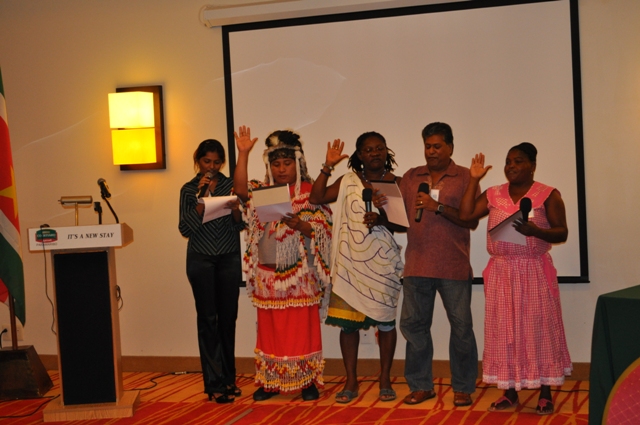
Participants pledge their commitment to work towards ending Gender-Based Violence, Paramaribo, Suriname

Source: http://www.caricom.org/jsp/photo_gallery/gender_based_violence_workshop/photogallery_gender_based_violence_workshop.jsp

Quote


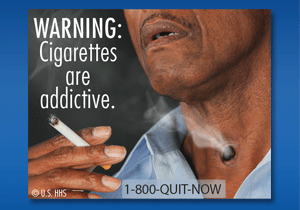
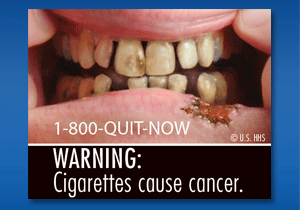
I wrote this headline earlier this month after the US announced more graphic designs for cigarette and other tobacco packaging and had intended to come back to it. I also started writing another post on a recent issue of The Lancet that covered various global studies on tobacco use. That’ll come at a later date. This month has been busy for me, and I hope to continue to post regularly. A lot is going on in public health that affects regional policies, including the recent International AIDS Society conference and the upcoming UN High Level Meeting on NCDs. I’ll try my best to bring more information about these events.

In the meantime, back to  what this post was meant to be about…what impact, if any, do graphic labels on cigaret and other tobacco products has on its use? The U.S. Food and Drug Administration, the regulatory agency for tobacco advertising, will begin requiring these images next year. Now, tobacco use has not been a mjpr issue among Caribbean youths. However, studies show behavior change once many people migrate to the United States. For the Unites States, this is

“a significant advancement in communicating the dangers of smoking.”

Now, having lived in Europe, I am used to seeing these images and oftentimes, their advertising go much further than the US ever will. However this is a start, as much of our merchandise from the region, including tobacco products, comes from US distributors.

In addition to the graphic images, more research is showing the impact of global mass media campaign:

“more than 1.9 billion people live in the 23 countries that have implemented at least one strong campaign within the last two years”

According to the WHO report on the global tobacco epidemic, 2011. “We are pleased that more and more people are being adequately warned about the dangers of tobacco use,” says WHO Assistant Director-General for Noncommunicable Diseases and Mental Health, Dr Ala Alwan. “At the same time, we can’t be satisfied that the majority of countries are doing nothing or not enough. We urge all countries to follow the best-practices for reducing tobacco consumption and to become Parties to, and fully implement, the WHO Framework Convention on Tobacco Control.”

What activities does your country engage in to reduce tobacco use? Do you see graphic images on packaging in your country? In your opinion, what impact does it have on reducing tobacco use? Do you anticipate these labels making their way to the Caribbean? How can our local governments and regional public health agencies prevent the uptake of smoking and other tobacco use among Caribbean people?

Source: http://www.who.int/mediacentre/news/releases/2011/tobacco_20110707/en/index.html