Haiti two years after earthquake; 15 months after Cholera outreak

Today marks the second anniversary of the Haiti Earthquake, one of the most devastating disasters in the region. In the aftermath of the earthquake, the spread of cholera was one of the many challenges faced across the nation. Since the outbreak in October 2010, more than one million cases have been reported; with about 7000 deaths. More than a year after the first reported cases, about 200 people each day are being diagnosed with cholera.

This week, the Pan American Health Organization, along with officials in Haiti, the Dominican Republic and the United States met to discuss ways to not only control the disease but to completely eliminate it on the twin-nation island. Much will need to be done in rebuilding Haiti structurally in order to stem this outbreak. In particular, the country needs to find ways to build an effective sewer system and to get clean water to its citizens. On the other hand, behavioral changes made through understanding and awareness of the steps that each individual can take to protect themselves–hand washing, boiling water and proper latrine use–are still needed.

I remember attending a TedX event a few months ago where a USAID official spoke about  using text messaging and radio programming for education purposes. Because of low-literacy rates, communication experts have to be careful what format they choose to use when reaching out to that community. As such, using text messaging and radio are just is two ways for people to get the message. Thinking on this also leads me to the many studies from the Positive Deviance Initiative and their approach to behavior change. Are there people in Haitian communities that are doing things right to stave off Cholera, despite all the challenges? What are they doing right? What steps are they taking? And, how can someone else in that same community with the same (limited) resources replicate those steps?  If anyone knows of how this is being manifested in Haiti, I’m interested in hearing about it.

Can ICTs help eliminate health inequities? Join #esac on Thurs., Jan 12th @ 7PM to find out

Happy New Year!

I know we’re well into January, but now is as good a time as any to begin blogging again.

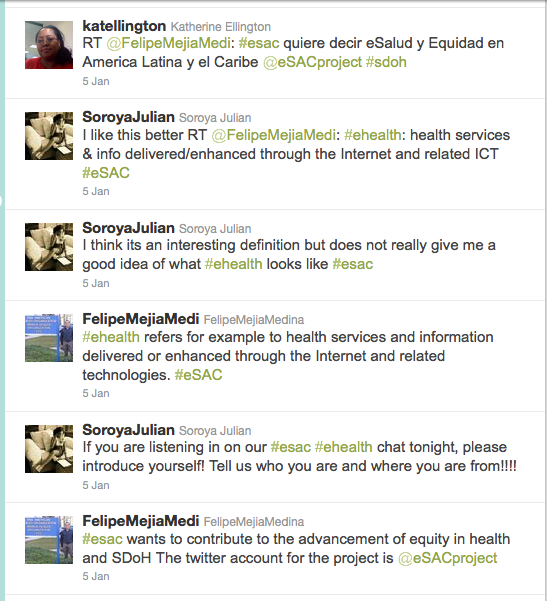
First up, the folks over at PAHO’s Public eHealth Innovation and Equity in Latin American and the Caribbean (eSAC) have been hosting another Twitter Chat tomorrow evening (Thursday, Jan 12th) at 7pm EST; #esac. If you missed last week’s chat, I’m including a screenshot of a portion of it. If you have any questions related to health inequities/health disparities in Latin America and the Caribbean, and the role of ICTs (management information services, data sharing networks, web 2.0/3.0 applications such as blogs and mobile apps) in combating those, this is the people to connect with.

So join tomorrow’s chat. Log in to Twitter at 7PM EST and use the hashtag ecas (#esac).


Why?

This is one of those things that has to be filed under “you gotta be kidding me, right?” I was searching for some information today and needed to access the resources of the Caribbean Public Health Agency. Now, being new entity, and one that strives for credibility, I am expecting to be able to access their website 24/7. Well, I can forgive cases where they are doing upgrades. But, what exactly would account for godaddy.com telling me that the website expired yesterday (12/08/2011) and “is pending renewal or deletion”. Is the agency switching to a new address? If not, didn’t someone receive numerous messages concerning the expiration date of their registration? I’m just saying! I obtained a web address through godaddy.com. That registration expires in three months from now, and I’ve already obtained an email telling me to renew. Please get it together people. I need my information.


mHealth Summit 2011: EHealth: Exploring Innovation and Collaboration in The Americas (Dec 5-7)

If you’re interested in the intersection of technology and health, then the upcoming mHealth Summit (December 5-7, 2011) promises to be a place to meet excellent minds who are working to use technology to address global healthcare needs.

On Tuesday, my friend Soroya Julian will be part of a part of a panel presentation on PAHO’s eHealth Strategy for the Americas.

The full schedule is available at http://www.mhealthsummit.org/about_overview.php

EHealth: Exploring Innovation and Collaboration in
The Americas

Tuesday, December 6, 2011, 3:30–5:00 PM

Overview: The purpose of this panel is to present two innovative and collaborative initiatives, destined to address the issues of inequities in health, in Latin America and the Caribbean (LAC). Health disparities between groups with different levels of underlying social advantage are the product of the action of factors know as the social determinants of health, which include, among many others, poverty, gender and ethnicity.

As a response to this reality, the Pan American Health Organization (PAHO/WHO) has launched its eHealth Strategy for the Americas, which intends to promote the use of ICTs in the healthcare scenario. During the first part of the panel, keynote-speakers of PAHO’s Knowledge Management and Communication Area will share information regarding this important regional strategy. The second part of the panel will highlight another regional initiative: Public eHealth Innovation and Equity in Health in Latin America and the Caribbean, coined eSAC.

This is a regional project, funded by the Ottawa-based International Development Research Centre (IDRC), whose ultimate goal is to contribute to the advancement of equity in health in the LAC region through the application of innovative Public eHealth solutions. It is jointly designed and implemented by the PAHO and the People, Health Equity and Innovation (Phi) Research Group at the University of Toronto, who will be presenting an overview together with a group of facilitators selected to spearhead the program.

http://www.mhealthsummit.org/about_overview.php

Sessions and Events at the Conference Focusing on HIV Stigma and Discrimination @2011 Caribbean HIV Conference

Making the Case: Stigma, Evidence, and Health Systems Strengthening in the Caribbean

Saturday, November 19, 5:00-6:30PM
Location : Grand F
Type: Special Sessions
Moderators:
Michel de Groulard , UNAIDS
Ayana Hypolite, PANCAP
This session will provide an overview of current evidence and challenges in understanding and addressing stigma and discrimination. It will explore possibilities in conceptualizing and articulating stigma and discrimination so as to make a better case on the importance of effectively reducing stigma and discrimination to policy makers and the general public. To set the stage, the session will include a presentation on stigma and disease and the current situation and challenges for the Caribbean. A member of the PANCAP Regional Stigma and Discrimination Unit will provide an overview of key findings in the 2011 assessment of stigma and discrimination in the Caribbean, followed by a presentation on what works in programming for health services and how to measure success. Finally a respondent will discuss implications for the Caribbean.

Speakers
1. Christine Barrow: Challenges and Lessons on Stigma from the Caribbean
2. Sarah Adomakoh: Assessment findings related to stigma and discrimination in the Caribbean
3. Laura Nyblade: Programming for stigma reduction: what works in health care settings? What do we know about measuring stigma and discrimination in health care settings?
4. Respondent: Maurice Tomlinson, Jamaica

Making it Work: Measuring Stigma and Discrimination in Health Care Settings
Monday, November 21, 4:30-6:30PM
Location: Adonis III
Moderators:
Ken Morrison, México
Laura Nyblade, USA
Elizabeth Lloyd, Trinidad and Tobago

This is an interactive skills-building session that will share recent developments in measuring stigma and discrimination in health care settings, presenting measurement tools and methodologies. It will also include participatory review of indicators for measuring sigma in health care settings. At the end of the session, participants will be more familiar with up-to-date tools and approaches for measuring stigma and discrimination in health care settings in the Caribbean.

Plenary Session III and Closing Ceremony: Looking to the Future
Monday, November 21, 11:00-12:30AM
Location: Imperial E/F/G/H/IA
An AIDS-free Caribbean requires investment in Stigma and Discrimination.
Dr. Farley Cleghorn, Vice President, Futures Group.

Stigma Booth: “Responding to Stigma and Discrimination in the Caribbean”
November 18-21
Location: Booth #2, Grand Foyer, Atlantis
Organized by PANCAP implementing partners with the support of Health Policy Project and Futures Group.
The above sessions are supported in part by the Health Policy Project in collaboration with PANCAP implementing partners.

The Health Policy Project is a five-year cooperative agreement funded by the U.S. Agency for International Development (USAID) under Cooperative Agreement No. AID-OAA-A-10-00067, beginning September 30, 2010. It is implemented by Futures Group, the Centre for Development and Population Activities (CEDPA), Futures Institute, Partners in Population and Development Africa Regional Office (PPD ARO), Population Reference Bureau (PRB), Research Triangle Institute (RTI) International, and the White Ribbon Alliance for Safe Motherhood (WRA).

Additional sessions focused on HIV Stigma and Discrimination

Stigma and Health Professionals
Saturday, November 19, 5:00-6:30PM
Location : Hermes Room
Moderators:
Suzette Moses-Burton

Presentations
• HIV/AIDS stigma and health professionals in Puerto Rico: Research findings and implications for its reduction.
Nelson Varas-Diaz, Puerto Rico
• Fear of HIV/AIDS and perception of personal risk: Examining the impact on stigma.
Rosana Yearwood, Trinidad and Tobago
• Designing an HIV Prevention Medical Education Curriculum for Hispanic Medical Students at the University of Puerto Rico Medical School: A Model for the Caribbean.
Clemente Diaz, Puerto Rico
• Health care students’ willingness to interact with patients living with HIV/AIDS (PLWHA): Examining the influence of attributions, prejudicial evaluation, perception of occupational risk and emotions.
Janiel Philip, Trinidad and Tobago

Stigma, Culture and Risk
Sunday, November 20, 3:00-4:00PM
Location : Hermes Room
Moderators:
Christine Barrow

Presentations
• Credibility of the “AIDS Mary” contemporary legend among college students in the Dominican Republic: framing the HIV-related stigma.
Marija Miric, Dominican Republic

Gender-Based Perspective on Stigma and HIV Risk
Sunday, November 20, 5:00-6:30PM
Location : Grand A
Moderators:
Nanet Lopez-Cordova

Presentations
• Gender Dimension of HIV-related stigma in the Dominican Republic.
Dulce Almonte Ledesma, Dominican Republic
• Developing a Computerized HIV Screening Instrument for Women at Risk for or Experiencing Violence. Jenny Namur Karp, USA

RSDU Pilot Series
Monday, November 21, 2:00-4:00PM
Location: Adonis II
•Development of a Community Driven Rights-Based Stigma
Response Model: Human-Rights Messaging Campaigns
in St Lucia, Jamaica and Dominica
Cheryl Gill-Eversley, Barbados

Increased awareness of human rights is an important prerequisite to expanding the rights-based approach to stigma reduction in the Caribbean. This workshop will present a community-driven, rights-based stigma response model that was developed and tested in response to calls from national AIDS programmers and other key stakeholders to develop strategies that effectively engage communities.