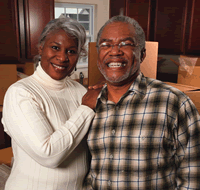
End-of-life decisions–one of the most difficult topics to talk about

Have you told your family what to do if you were in a critical state? Have you talked to your loved ones or medical professional about their decisions?

A few years ago, my great grandfather, who suffered from cancer told us emphatically that he did not want anyone keeping him on ‘drips’ or life support. He was dying and he was ready to go. The family honored his wishes, for he has always been obstinate and forthright. He’d lived a long and happy life and knew that staying any longer would not make life any better. How many other people know when it’s time to let go? How many other families are refusing to let go?

End of life decisions are nothing lightly to discuss. In my great-grandfather’s case, he had advanced stage cancer. What about when it’s a young person who may have been in an accident, ends up in a coma, and the family tries to hold on in hopes of the person becoming conscious again?

A few weeks ago, popular medical drama Grey’s Anatomy aired an episode in which a young adult had to make end-of-life decisions on behalf of her parents. The family had been in an accident. The mother died on the scene. The father was hospitalized but needed to be resuscitated numerous times. A doctor asked the young lady about any discussions she had had with her parents about whether they wanted to be kept alive. She responded, “We don’t talk about things like that. We talk about normal things.”

Well, end of life decisions should become part our or new normal medical discussions. As we live longer and become engaged with more medical technologies, we need to start talking to each other–young and old–about what you want to happen if placed in a situation where you are unable to make medical decisions on your own.

In the middle of writing this post, I learned that my father had suffered an accident on the job. Although he was not badly hurt, I saw this as a clue for my own family to start making this part of our ‘normal things’. This decision was also made easier because my dad often spoke of how he wants his body handled after he dies.So, communicating about what to do if something serious happens was a natural follow-up question.

Andre Robb to Rep Caribbean in UNAIDS ‘CrowdOutAIDS’ Campaign!

The United Nations Joint Programme on HIV/AIDS (UNAIDS) is using a non traditional method called crowdsourcing to develop the new UNAIDS secretariat strategy. Crowdsourcing is the act of taking a job traditionally performed by a designated agent (usually an employee) and outsourcing it to an undefined, generally large group of people in the form of an open call (Jeff Howe).

24 year old Andre Robb of Jamaica will join 9 other young adults from around the world, who have been selected as a part of this process. They will form a committee which will spend the next couple of weeks in training, analyzing the data, then using various online tools to collaborate on the development of the strategy.

Andre has worked for the government and civil society on Youth Development, HIV programmes and comprehensive sexuality education programmes in Jamaica. Andre’s advocacy in his country allows him to represent young people on local and international committees and working groups. He is now committed to building social innovation and social entrepreneurship among young Caribbean change makers. Follow him on Twitter:@robbizle7. No doubt Andre will be seeking to advocate for our region’s specific needs in this strategy, but be sure to tweet him and let him know your thoughts.

Meet the entire #CrowdOutAIDS Drafting Committee members: http://shar.es/WRADI

Got Twitter? Join the #esac chat tonight

Hey,

The folks over at PAHO’s Public eHealth Innovation and Equity in Latin American and the Caribbean (esac) are hosting their weekly eHealth chat this evening. Join the Twitter conversation to learn how we can harness emerging technologies to reduce health disparities across the region.

https://twitter.com/#!/eSACproject/status/159406188021293056


CBMP launches ‘Man a Man: Live Up’ video competition

The theme for the competition is “Faddahood and manliness inna dis ya century”.

With the contest, Caribbean Broadcast Media Partnership on HIV/AIDS seeks to engage 18-24 year old Jamaicans to showcase their talent by creating an original two (2) minute video in any format from a music video, dramatic short, blog, podcast, editorial commentary, documentary and animation as long as it meets the competition rules for submission.

This competition is just one of the collaborative initiatives under the CBMP and PSI/Caribbean partnership umbrella of the CARISMA II project which aims to highlight the social issues impacting on HIV prevention across the Caribbean region. “Our constructs of masculinity and fatherhood in the region significantly influence the behaviours linked to some of the structural drivers of HIV and we saw this as an innovative way to hear from young people in Jamaica how they think about these issues in order to help us craft more relevant and meaningful programmes.”says Dr. Allyson Leacock, Executive Director of CBMP.

The ‘Man A Man: LIVE UP’ video competition videos will be showcased on YouTube with the top ten finalists’ submissions uploaded to Facebook at a later date. The competition has a first prize of USD $2,500 cash, a Digicel mobile phone, LIVE UP and Got IT? Get IT t-shirts plus many more items. The winning videos will also be shared with the CBMP 110 member stations in 24 Caribbean countries

Check out www.manaman.iliveup.com for more information.

mHealth. eHealth. Are they that different?

I want to say thanks to @SoroyaJulian for inviting me to the #esac Twitter chat. I see this as a great resource for learning about eHealth, Public eHealth, mHealth and other concepts we hear so much about.Here’s a quick rundown of what went on.

https://twitter.com/#!/FelipeMejiaMedi/status/157619500563447808

https://twitter.com/#!/katellington/status/157619995692638208

One of the things I wanted to learn about was the difference, if any, between mhealth and ehealth. Felipe Mejia Medi, who facilitated the charts, did a great job of helping us decipher the nuances between the two.

https://twitter.com/#!/FelipeMejiaMedi/status/157621068805308416

https://twitter.com/#!/DianeBFrancis/status/157624568238981120

So, if you like the conversation so far, you don’t have the wait until next Thursday’s (@7PM EST) chat. This being Twitter, I’m sure you can have your say at any time. Just make sure to use the hashtag esac (#esac). Do you have another definition for ehealth? Is there really a difference between mhealth and ehealth?

Join the conversation and follow me @DianeBFrancis.