Quote

This article was cross-posted from the Whitehouse.gov blog. Dr. Garth Graham is Deputy Assistant Secretary for Minority Health at the U.S. Department of Health and Human Services. (Cross-posted from the Office of National AIDS Policy Blog.) It was originally posted on June 8, 2010, but I thought it still relevant today. 

Caribbean American communities are incredibly diverse and have contributed greatly to the growth of this Nation.  I learned from watching my mother, who worked as a nurse taking care of sugar cane plantation workers, not only the importance of hard work and dedication but also the importance of family and community.  As a community, we face a significant challenge in tackling HIV. Even though Caribbean Americans comprise less than 10 percent of the total U.S. population, they are included in the disproportionately high rate of new HIV/AIDS diagnoses that occur in Black Americans. As a clinician and a professional in the field of public health, I have seen those challenges first hand. Yet as member of the community, I also know what we can accomplish if we work together. Caribbean American leaders can play an especially important role in the community to promote HIV awareness to address this public health issue. To help prevent HIV/AIDS, community leaders and care providers need to communicate about HIV in culturally relevant and linguistically appropriate ways.

As with other racial and ethnic minority communities, many Caribbean Americans have taboos against discussing sexual matters related to HIV risk. There is stigma associated with men having sex with men in some Caribbean American communities, and this challenge may influence some individuals to avoid getting tested for HIV.  Delayed HIV testing and diagnosis among Caribbean Americans seriously endangers their health and the health of their sexual partners. We must be clear and open in discussing the risk factors associated with HIV and all work to reduce barriers to testing and treatment. With regular testing to identify new HIV infections, individuals who test positive can have the opportunity to receive appropriate care and treatment to prolong their lives and reduce the chances of infecting others.

Federal partners including HHS have been working with the White House Office of National AIDS Policy (ONAP) to develop a National HIV/AIDS Strategy using input from the public, to improve our response to the epidemic in the U.S.  Active involvement by individuals and stakeholders including state, territorial, and local governments will be important in implementing the national strategy. The HHS Office of Minority Health will continue to partner with other agencies and organizations to support capacity building in hard-hit communities, improve care providers’ cultural competency, conduct outreach, and help people to get educated about HIV, get tested, and get treated. We are targeting those hardest hit by the epidemic – for example, our HIV/AIDS Health Improvement for Re-entering Ex-Offenders Initiative (HIRE) program bridges healthcare gaps that exist with the AIDS epidemic to improve the HIV/AIDS health outcomes of ex-offenders re-entering the mainstream population by supporting community-based efforts to ensure their successful transition from state or federal incarceration back to their communities.

Today, we recommit with others around the country to improve the lives of people living with HIV/AIDS. I learned a saying from my mother that not all silence is golden, and silence isn’t golden when it costs lives. On this Caribbean American HIV/AIDS Awareness Day, let’s raise our voices together to empower Caribbean American communities to challenge the stigma surrounding the disease in order to help reduce new infections and better serve people living with HIV. Let’s aim to reach our communities with a message focused on prevention and testing, understanding that if we work together we can continue to achieve great things, one of the greatest being an end to the HIV epidemic.

Garth Graham, M.D. is the Deputy Assistant Secretary for Minority Health at the U.S. Department of Health and Human Services.

Quote

There have been so much negative press about the amount of time people spend online and in virtual environments and the effects on psychological and physiological processes that when a new study comes out espousing the positive qualities of virtual worlds such as Second Life, it has to make news right?

Today, BBC Health is reporting that researchers at Indiana University compared participants in a 12-week weight loss program-one real, one online-and that they lost almost the same around of weight. For the intervention, the researchers recruited overweight and obese people who met four hours a week in either the online or offline environment.

So, how much did the groups lose? The average weight loss was 10 pounds. Healthy for a 12-week program.

“However, when the groups were surveyed on whether their overall behaviour had changed, those using Second Life appeared to have made more changes towards healthy eating and physical activity, suggesting that they might fare better in the future.”

This is a really good step for intervention research in in any world. And I’m sure prevention scientists are also considering this news, especially in light of the finding that those in Second Life experienced overall behavior change.

There has been a move towards tailored health communication and health interventions in the past few years. Beyond the real and the virtual, this article did not report on whether the researchers tailored the interventions to specific needs of different groups. That might have been one of the study’s limitations.

Another limitation is that many of these studies and interventions can–for now–only be done in certain countries. Many of the world’s overweight and obese people are in the developing world. What impact, if any, would a study such as this have on them? Can something similar be done in our region? Do we have enough people visiting online worlds to really put money towards an intervention such as this? What other ways can this be done? Though online community boards where islanders congregate? Would you use Second Life or another virtual environment to help you lose weight?

Source: http://www.bbc.co.uk/news/health-13643471

Quote

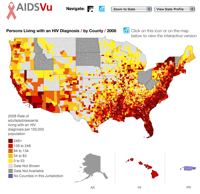
I’m always intrigued by the intersection of new media/new technology and public health. And this past week, leading to the 30th anniversary of the first reports AIDS case, Emory University unveiled a new website: AIDSVu.org. Using data from local HIV testing sites, county, state and national HIV data, the website shows an interactive map of the United States with county-level HIV rates for adults/adolescents per 100,000.

One weakness of the site is that there is no information for Puerto Rico and the U.S. Virgin Islands. However, there is hope that the site will include such information at a later date. Additionally, the interactive map has potential to be a global resource with the inclusion of surveillance data from across the Caribbean and the world. My health communication professor at the University of Southern California espoused the importance of data representation for public health and healthcare. Seeing this website, I am better able to understand why he strongly believes that any data communicated should be done in such a way that is not only informative but that can be easily digested by the lay public.

So, what’s the importance of this map for Caribbean audiences? It’s important because one can look at the map to see where Caribbean populations live and try to extrapolate the rate of HIV in that area. As the website noted, caution should be taken when interpreting this map because it included the prison populations–reported at the country level–which may increase the rate on that county. Nevertheless, the ability of the map to communicate the who and where people are affected in there.

What do you think of this interactive tool? How else can this technology be used?

Quote

Public eHealth is an inclusive term that encompasses all of the possible applications of information and communication technologies (ICTs) to public health and related disciplines. Public eHealth includes both traditional applications, such as management information systems, databases, and data sharing networks, and more recent and innovative ones, such as those supported by Web 2.0 solutions.

The project seeks to unite and strengthen the principles of transparency, ethics, and equity through the innovative use of ICTs to enable better health care delivery and access, particularly among undeserved populations.

The eSAC project integrated approach includes:

  • the introduction of various types of incentives to stimulate innovation;
  • support to communication and networking activities;
  • capacity development opportunities;
  • the evaluation of solutions based on information and communication technologies (ICTs) that address priority public health challenges in the region; and
  • activities aimed at informing and sensitizing policy makers.
Additional information on the program, it’s significance and how to apply can be found at: http://new.paho.org/ict4health/index.php?option=com_content&view=article&id=46&Itemid=45&lang=en
Quote

News this week of the possible link between cell phones and cancer has been all the buzz across the global media landscape. The findings, reported by the World Health Organization found a possible link that radiation from cell phones may be carcinogenic. This is, of course, non conclusive. In a word where there are almost as many cell phones as there are people (Washington Post’s Post Tech put the number at move than five billion) cell phones are not juts ubiquitous, they have also become an essential part of daily life for many.

According to the Washington Post,

Cellphones are “possibly carcinogenic” to humans, according to the panel organized by the World Health Organization. But an exhaustive, eight-day review of hundreds of studies concluded that the existing evidence is insufficient to know for sure. And because cellphones are so popular, further research is urgently needed, the experts said.

The phrasing “possibly carcinogenic” is on a Likert-type scale ranging from carcinogenic to probably not carcinogenic, and is considered the third-highest rating…just below “probably carcinogenic”.

Can anyone out the WHO and public health institutions tell the difference between “probably carcinogenic”  and “possibly carcinogenic”?  in media and communication studies, there is much research on how people ‘read’ the news and other mediated information. I do wonder, when you heard of this, what first came to mind? How many articles did you read on this topic? Did you jump to the conclusion that a “possible” link means one is eminent? Did the media/news sources help you come to that conclusion?

Source: http://www.washingtonpost.com/national/cell-phones-possibly-carcinogenic-who-says/2011/05/31/AGRktZFH_story.html?hpid=z1