Videos from 2011 Caribbean HIV Conference – Sheryl Lee Ralph ‘Sometimes I Cry’

For those of us who were unable to make last years’ Caribbean HIV Conference, the organizers have placed videos of the conference on Youtube. You can video the majority of the conference, from the opening Flag ceremony to the closing remarks.

In the video below, actress/AIDS activist Sheryl Lee Ralph gives a powerful performance of her one-woman show “Sometimes I Cry“, which details the lives, loves and losses of women infected and affected by HIV and AIDS.

Can ICTs help eliminate health inequities? Join #esac on Thurs., Jan 12th @ 7PM to find out

Happy New Year!

I know we’re well into January, but now is as good a time as any to begin blogging again.

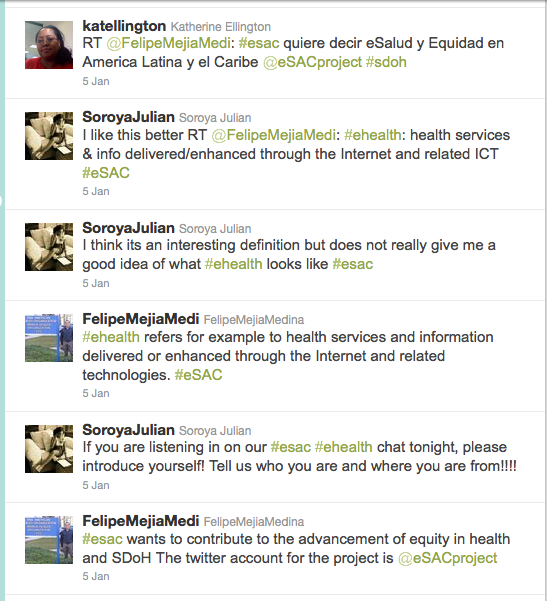
First up, the folks over at PAHO’s Public eHealth Innovation and Equity in Latin American and the Caribbean (eSAC) have been hosting another Twitter Chat tomorrow evening (Thursday, Jan 12th) at 7pm EST; #esac. If you missed last week’s chat, I’m including a screenshot of a portion of it. If you have any questions related to health inequities/health disparities in Latin America and the Caribbean, and the role of ICTs (management information services, data sharing networks, web 2.0/3.0 applications such as blogs and mobile apps) in combating those, this is the people to connect with.

So join tomorrow’s chat. Log in to Twitter at 7PM EST and use the hashtag ecas (#esac).


Sessions and Events at the Conference Focusing on HIV Stigma and Discrimination @2011 Caribbean HIV Conference

Making the Case: Stigma, Evidence, and Health Systems Strengthening in the Caribbean

Saturday, November 19, 5:00-6:30PM
Location : Grand F
Type: Special Sessions
Moderators:
Michel de Groulard , UNAIDS
Ayana Hypolite, PANCAP
This session will provide an overview of current evidence and challenges in understanding and addressing stigma and discrimination. It will explore possibilities in conceptualizing and articulating stigma and discrimination so as to make a better case on the importance of effectively reducing stigma and discrimination to policy makers and the general public. To set the stage, the session will include a presentation on stigma and disease and the current situation and challenges for the Caribbean. A member of the PANCAP Regional Stigma and Discrimination Unit will provide an overview of key findings in the 2011 assessment of stigma and discrimination in the Caribbean, followed by a presentation on what works in programming for health services and how to measure success. Finally a respondent will discuss implications for the Caribbean.

Speakers
1. Christine Barrow: Challenges and Lessons on Stigma from the Caribbean
2. Sarah Adomakoh: Assessment findings related to stigma and discrimination in the Caribbean
3. Laura Nyblade: Programming for stigma reduction: what works in health care settings? What do we know about measuring stigma and discrimination in health care settings?
4. Respondent: Maurice Tomlinson, Jamaica

Making it Work: Measuring Stigma and Discrimination in Health Care Settings
Monday, November 21, 4:30-6:30PM
Location: Adonis III
Moderators:
Ken Morrison, México
Laura Nyblade, USA
Elizabeth Lloyd, Trinidad and Tobago

This is an interactive skills-building session that will share recent developments in measuring stigma and discrimination in health care settings, presenting measurement tools and methodologies. It will also include participatory review of indicators for measuring sigma in health care settings. At the end of the session, participants will be more familiar with up-to-date tools and approaches for measuring stigma and discrimination in health care settings in the Caribbean.

Plenary Session III and Closing Ceremony: Looking to the Future
Monday, November 21, 11:00-12:30AM
Location: Imperial E/F/G/H/IA
An AIDS-free Caribbean requires investment in Stigma and Discrimination.
Dr. Farley Cleghorn, Vice President, Futures Group.

Stigma Booth: “Responding to Stigma and Discrimination in the Caribbean”
November 18-21
Location: Booth #2, Grand Foyer, Atlantis
Organized by PANCAP implementing partners with the support of Health Policy Project and Futures Group.
The above sessions are supported in part by the Health Policy Project in collaboration with PANCAP implementing partners.

The Health Policy Project is a five-year cooperative agreement funded by the U.S. Agency for International Development (USAID) under Cooperative Agreement No. AID-OAA-A-10-00067, beginning September 30, 2010. It is implemented by Futures Group, the Centre for Development and Population Activities (CEDPA), Futures Institute, Partners in Population and Development Africa Regional Office (PPD ARO), Population Reference Bureau (PRB), Research Triangle Institute (RTI) International, and the White Ribbon Alliance for Safe Motherhood (WRA).

Additional sessions focused on HIV Stigma and Discrimination

Stigma and Health Professionals
Saturday, November 19, 5:00-6:30PM
Location : Hermes Room
Moderators:
Suzette Moses-Burton

Presentations
• HIV/AIDS stigma and health professionals in Puerto Rico: Research findings and implications for its reduction.
Nelson Varas-Diaz, Puerto Rico
• Fear of HIV/AIDS and perception of personal risk: Examining the impact on stigma.
Rosana Yearwood, Trinidad and Tobago
• Designing an HIV Prevention Medical Education Curriculum for Hispanic Medical Students at the University of Puerto Rico Medical School: A Model for the Caribbean.
Clemente Diaz, Puerto Rico
• Health care students’ willingness to interact with patients living with HIV/AIDS (PLWHA): Examining the influence of attributions, prejudicial evaluation, perception of occupational risk and emotions.
Janiel Philip, Trinidad and Tobago

Stigma, Culture and Risk
Sunday, November 20, 3:00-4:00PM
Location : Hermes Room
Moderators:
Christine Barrow

Presentations
• Credibility of the “AIDS Mary” contemporary legend among college students in the Dominican Republic: framing the HIV-related stigma.
Marija Miric, Dominican Republic

Gender-Based Perspective on Stigma and HIV Risk
Sunday, November 20, 5:00-6:30PM
Location : Grand A
Moderators:
Nanet Lopez-Cordova

Presentations
• Gender Dimension of HIV-related stigma in the Dominican Republic.
Dulce Almonte Ledesma, Dominican Republic
• Developing a Computerized HIV Screening Instrument for Women at Risk for or Experiencing Violence. Jenny Namur Karp, USA

RSDU Pilot Series
Monday, November 21, 2:00-4:00PM
Location: Adonis II
•Development of a Community Driven Rights-Based Stigma
Response Model: Human-Rights Messaging Campaigns
in St Lucia, Jamaica and Dominica
Cheryl Gill-Eversley, Barbados

Increased awareness of human rights is an important prerequisite to expanding the rights-based approach to stigma reduction in the Caribbean. This workshop will present a community-driven, rights-based stigma response model that was developed and tested in response to calls from national AIDS programmers and other key stakeholders to develop strategies that effectively engage communities.

PANCAP Happenings at the 2011 Caribbean HIv Conference

The Caribbean HIV conference begins tomorrow. And for the past two weeks, I’ve been getting e-mails about various events at the conference. Here’s what PANCAP will be offering.

 PANCAP Happenings at the Conference

Friday 18 November (Imperial Ballroom)
PANCAP Awards of Excellence and Recognition
Opening Ceremony of the 2011 Caribbean HIV and AIDS Conference

Saturday 19 November – Poster Presentation (Grand B – 04)
Fostering a Harmonised HIV Response in Caribbean Countries: Alignment of Country Strategic Planning With the Caribbean Regional Strategic Framework
Dr. Ingrid Cox-Pierre, Strategy and Resourcing Officer, Care and Treatment, PCU

Saturday 19 November – Poster Presentation (Grand B – 08)
Implementing a Multi-Country HIV Workplace Programme in Caribbean Countries: A PANCAP Approach
Dr. Morris Edwards, Head, Strategy and Resourcing, PCU

Sunday 20 November – Poster Presentation (Grand B – 10 )
Creating an enabling environment for universal access to care, treatment and support through regional model HIV anti-discrimination policy and legislation
Ms. Ayana Hypolite, Strategy and Resourcing Officer, Stigma and Discrimination

Saturday 19 – Sunday 20 November – Poster Display (Grand E – 21)
Creative partnerships to resolve unmet HIV prevention needs of students at regional tertiary level institutions
Dr. Morris Edwards, Head, Strategy and Resourcing, PCU

Saturday 19 – Sunday 20 November – Poster Display (Grand D – 48)
Improving standards of psychosocial care and support for people living with HIV and most at risk communities in the Caribbean through professional guidelines
Ms. Ayana Hypolite, Strategy and Resourcing Officer, Stigma and Discrimination

Saturday 19 November – Concurrent Session (Grand G)
Ensuring Positive Health, Dignity & Prevention are Embedded in NSPs
Ms. Valerie Beach-Horne, Strategy and Resourcing Officer, Prevention

Sunday 20 November – Oral Presentation (Grand B)
Legal Responses to Governance issues in PANCAP
Ms. Volderine Hackett, Head, Strategic Information and Communication, PCU

Monday 21 November – Oral Presentation (Grand E)
Implementing Best Practice in HIV Prevention Programmes
Ms. Valerie Beach-Horne, Strategy and Resourcing Officer, Prevention

Sunday 20 November – Special Session (Grand F)
How to Improve Access to HIV Services for Migrants in the Caribbean
Dr. Robert Cazal, Project Coordinator, PANCAP/GIZ/EPOS Project “Improving Access of Migrant Populations to HIV Services in the Caribbean”

Web-based MSM survey going on now

This news comes by way of PANCAP.

“The first of its kind in the Caribbean, CARIMIS: Caribbean Men Internet Survey 2011 is happening all over the Caribbean. It is the largest ever Caribbean survey of gay men, transgender, bisexual men and other men who are attracted to men. It is an initiative of the UNAIDS Caribbean Regional Support Team.

“It asks about relationships, sex life, risks and precautions and use of health services. One of the goals is to see whether gay men and other men who have sex with men (MSM) have access to HIV testing and prevention.

In the Caribbean, HIV prevalence among the MSM population ranges from 6.7 percent in Suriname to 32 percent in Jamaica. This is compared to an estimated adult prevalence in the region of one percent. The need to respond meaningfully to the MSM community in the Caribbean is obvious and urgent yet little is known about this key population.

“With this in mind, the CARIMIS seeks to collect information about the lives of MSM throughout the English, French, Spanish and Dutch-speaking Caribbean over a three month period starting from October 2011. The internet based survey is anonymous and the questionnaire takes about 20 minutes to complete. It aims to assess behavioural risks among Caribbean MSM while reaching populations who are inaccessible through more traditional sampling methods.

“CARIMIS offers a new approach to collecting Caribbean-wide but country-specific HIV behavioural risk data that may complement current traditional national and regional MSM studies. This will enable UNAIDS as well as our HIV collaborating partners to better estimate the magnitude of the HIV epidemic among Caribbean MSM,” said research associate, Sylette Henry-Buckmire.

“It is expected that the internet interface will attract more honest responses and therefore offer a better understanding of HIV infection dynamics within the Caribbean MSM community. Also successful implementation of this web-based MSM survey will inform similar studies for other highly stigmatized groups such as commercial sex workers.”

For further information on CARIMIS please contact Dr. Michel de Groulard at degroulardm@unaids.org