Daniel Craig in drag for International Women’s Day 2011

Today marks the 100th anniversary of International Women’s Day. This year’s theme is “Equal access to education, training and science and technology: Pathway to decent work for women“.

In a much talked about ad, Daniel Craig (James Bond) takes on the role of a woman as Judi Dench narrates the plight of women in the UK and around the globe. “Women are responsible for two-thirds of the work done worldwide but earn only ten percent of the total income and one percent of total property. It’s not just about money and power.” She goes on to address women’s inability to get an education, sexual assaults committed against women and other crimes. So, are we equal?

For me, this day is a time of reflection on how I contribute to the advancement of women in my adopted country, my homeland and around the globe. I first got into my field because I wanted to be a voice for the usually voiceless: survivors of domestic violence and child abuse. As I get further along, I hope to use my research to continue to advocate for those women, children (and men) who are unable to speak up for themselves.

After all, although this is International Women’s Day, everyone, including men, have a role to play in advancing women’s issues. What are you doing today and every day to improve the lives of women?


Mr. Sheen Goes to Haiti

After much talk in the past week about Charlie Sheen’s ranting, the focus has now turned to his plans to join fellow actor Sean Penn in Haiti.

According to the article, “Sean Penn, who has tirelessly worked to bring attention and relief to the earthquake-stricken and impoverished country, invited old friend Charlie Sheen down to the island nation on Friday to lend a hand in the relief efforts.”

“In a statement, Penn said: “I think his energies, intelligence and passion could be both of service and servicing to him, as it is to all who are touched by the struggle of the Haitian people.””

The full article is available at http://www.huffingtonpost.com/2011/03/05/charlie-sheen-going-to-haiti_n_831770.html

Old news, recurring theme: Caribbean Media Overlook Health Stories

This is an almost five-year-old story, but I felt compelled to share it since this directly correlates with one of the reasons I began this blog. Haven ranted here and written here about my frustrations with media organizations in the region, I am excited (well, in one sense yes and in another so sad) to see published data on just how much health stories are not being covered. The report, from PAHO and CARIMAC analyzed print and electronic press in St. Vincent and the Grenadines, and found that

“only 16 percent of stories had a health angle, although an additional 19 percent had the potential for a health focus. The study also found that stories covering HIV/AIDS issues more often than not utilized overtly negative terminology.”

Since this was to be a pilot study (found here), I am hoping to get additional published data on the original study as well as follow-up investigations from other countries. What were the results? Are there any similarities and/or differences in the coverage of health news across these islands? Which stories were covered most? Through what lens? Who was most likely to be interviewed? Whose voice is present? Whose voice is missing?

Apart from the implications of these studies for media organizations, I am also concerned about the implications for the health of the people served by such news organizations.Various studies show that populations gleam a great deal of health information from reading/listening or viewing media and entertainment programs, including from reading news reports. By excluding health information from the agenda, or by including it but only through limited lens, new organizations are failing at proving their audience with vital public health information.

UVI researchers to discuss public health challenges associated with climate change on WTJX

Courtesy: http://myhealthwhatsclimategottodowithit.com/

Part if my life’s mission is to strengthen the research component at the University of the Virgin Islands, my alma mater, so, I am always excited when I see updates on what professors and investigators are doing in improve the public’s health. About two years ago, the university received a NIMHD grant to study the links between climate change and public health challenges and to increase public awareness of said challenges. Through this effort, the lead researchers at UVI, Drs. LaVern Ragster and Gloria Callwood will, present a program “Climate & Health: New Challenges for the Virgin Islands” on Sunday, March 6 on WTJX.

Part of the project objective is to reduce health disparities in the Virgin Islands. According to the website:

“With a population that is 76 percent African American/African Caribbean and 14 percent Hispanic or Latino ethnicity, the Virgin Islands is recognized as an area with a “vulnerable population”, in which numerous health disparities exist. The project specifically aims to: (1) Research and develop information supporting communications and strategies to address links between climate change and increasing public health challenges, specifically dengue fever and ciguatera (fish poisoning), and (2) Develop an effective educational outreach program focused on the prevention and mitigation of health problems associated with dengue and ciguatera.

I hope anyone living within viewing range of WTJX will tune in to hear what the researchers have to say, encourage more pubic health research in the Virgin Islands and share their thoughts on best practices for communication health and climate information to the public.

To learn more about the project, visit their website at http://myhealthwhatsclimategottodowithit.com/

New study links HIV testing centers with Domestic Violence screening and counseling

Courtesy Duke Global Health

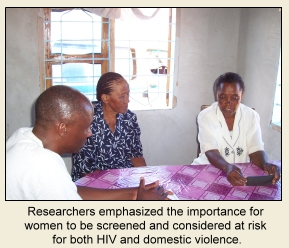
A new study from Duke University recently reported the recommendation of HIV intimate partner violence (IPV) screening at HIV voluntary counseling and testing centers (VTC). The study, conducted in Tanzania, interviewed more than 2400 women at the HIV VTC site, of which 20% reported physical or sexual violence during their lifetime. “Researchers found that domestic violence, defined in this study as intimate partner violence (IPV), was reported more often among women who are older, unemployed, less educated, married or divorced, and have children. Also, women with IPV were more likely to suspect HIV or infidelity in their sexual partner or have a sexual partner who has multiple partners.

This study has important implications for HIV and IPV interventions not just in Eastern and Southern Africa but also in the Caribbean region since there has been increased focus on DV, including child abuse, and IPV across the region.

In addition, studies such as this could also be conducted at DV centers to assess who within their population is most at risk for contracting HIV. I wanted to share this study because it reminded me of my own volunteer work in the Virgin Islands with a DV organization, and made me think of the various ways investigators could conduct studies within that population.

To read the full report on the Tanzania study, visit Duke Global Health website here.