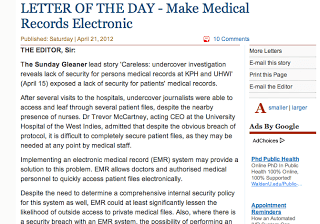
Working on a project promoting eHealth: the use of Information and Communication for Technology (ICT) for health, I realized (as I searched online newspapers) how little information there was. I decided, therefore, to put some information out there. The opportunity came for me when local journalists uncovered a lack of security for medical records in Jamaica’s two main public hospitals in Kingston. Here, I thought, I could make a case for electronic medical records, an area in eHealth.
I decided on a letter to the editor because:
1. It would be fast.
Because a letter to the editor is a simple opinion piece, I wouldn’t have to worry about carefully validated research or including the opinions of experts (interviews). All I would have to do it write my own opinion (in half an hour) and send it to the editor.
2. It was more likely to be published. This because the letter to the editor is specifically designed for participation from the public. Also the timeliness of the issue (the fact that it was responding to a recent lead story) would help.
The letter ended up highlighted as Letter of the Day and I received 10 comments on the online story (which is great for starting a conversation on the matter). For being chosen for letter of the day I also received a prize of a book voucher, which I donated to a school.
Health is having the opportunity to enjoy, compete, make choices and fully participate in life. Health in the Caribbean is related to the very SPIRIT of a person. Our traditions are as strong today as they were over 100 years ago when we would sing and dance even under the oppression of slavery, indentured servitude and eventually the fight for national independence. Today we still SING, DANCE, PAINT, SCULPT, DRAW, STORY-TELL, EAT, SWIM, RUN and PLAY with the same energy, with the same spirit, from the city of Kingston to even the town of Livingston on the shore of Guatemala. This is to be healthy, Caribbean style.
Originally posted on the blog of Soroya Julian on October 9, 2011.
Clowning as a communication strategy in sexual health communication: a partial, informal, playful but realistic assessment of the regional impact of the Proyecto Payaso South South Exchange programme.
Theatre is powerful. Full stop. Nothing else has the power to mirror reality and life and to make us see ourselves, our weaknesses, strengths, stupidity, vulnerabilities. It stands to reason, therefore, that if one wants to change behaviour, theatre or ‘drama’ is arguably the best method to do it. It was this belief that led me to Proyecto Payaso. Looking at their website on the internet, I was immediately drawn to the project, despite my initial desire to go to South America and not Central.
One of the interesting aspects of the project was its ‘South South’ exchange programme, and what seemed to me to be its defiance of traditional the North-South relationship. That is, dependence on the theories, advise and experience of the North to tackle the issues of the South. I was an instant convert, myself a native of the ‘South’ (Jamaican). I felt that there was so much beauty in the natural culture of the South and thought it sad that we did not share our experiences in more meaningful ways. For the first time I actually felt special that an organization wanted my knowledge and experience instead of that of my Northern counterpart.
Proyecto Payaso offers a model of sexual health communication to the region that is participatory, target driven and non traditional; and this is exactly why it works. The project employs local youth but they are not just blindly carrying out the mandate of the organization; they actually have a stake in it right up to the executive level. Meetings, training and evaluation activities are all designed to involve the clowns in the development of the project. I participated in the project at all levels as well, sharing experiences and envisioning how this kind of project would work in my own context.
One of the distinctive features of Proyecto Payaso, for me, was the fact that the ‘obras’ or plays were specifically adapted to specific target audiences, even within Guatemala. The play done in the female prison was different from those done at schools or with indigenous women or in the various regions. Targeting audiences specifically is an extremely important part of planning any campaign for behaviour change. The fact that this is the case shows the evidence based backbone of the project (no clowning around!).
One of the things I grappled with the most during my time at the project (especially during ‘clown training’) was how the project managed to use clowning as a method of tackling a serious issue (HIV). The clown, I realized, helped to introduce issues that were not easily discussed in this population, and was a more accepted figure as it was not seen as threatening.
The fact that similar models to the project have been created regionally because of the exchange programme in other Central and South American countries is a testament to the success of the programme. The exchange programme can have an impact on the individual, in the sharing of ideas and in the influence of ideology.
Repost from the previous blog of Soroya Julian (originally published on July 27, 2011)
The University of Technology’s (UTECH), School of Public Health and Health Technology (SPHHT) will host its 3rd International Public Health Conference, from October 3-6 2013 at the Jamaica Conference Centre, Kingston. This Conference will be of great significance to our region as we will be looking at common issues and strategies for solutions that will facilitate ongoing collaboration and sharing of expertise between the Territories of the Caribbean.
The Conference, under the Theme: “Challenges to Public Health in a Global Environment: – “Time for Action” will provide the framework for addressing concerns about the increasing incidence of lifestyle diseases in Jamaica the Caribbean.
The Conference Agenda will feature eight thematic scientific sessions which will bring focus to some of the critical issues and challenges faced nationally, regionally and internationally. These sessions include the following themes: Non-Communicable Diseases: Multi-Sectoral Action for Prevention, Environmental Health Challenges, Climate Change and Green/Healthy Cities, Disaster Preparedness and Response Occupational Health and Safety Risk Management, Best Practices for Advancement in Public Health, Food & Public Policy in the Caribbean: The Role of Public Health Nutrition, Public Health Nursing: Outreach and Intervention in Population at Risk.
The Caribbean Public Health Agency has an early call out for its 2014 conference. The theme for 2014 is Chronic Non-Communicable Diseases Through the Life Cycle. There has been an increased focus on the lifespan approach (i.e. from childhood through elderly) to disease prevention and this conference aims to understand how these concepts are incorporated into the Caribbean context. This is an excellent opportunity for anyone conducting longitudinal health communication research to present their findings. The deadline for submission is November 1, 2013. The conference is scheduled for from May 1-3, 2014, in Aruba.



 Caribbean Health Communication Blog