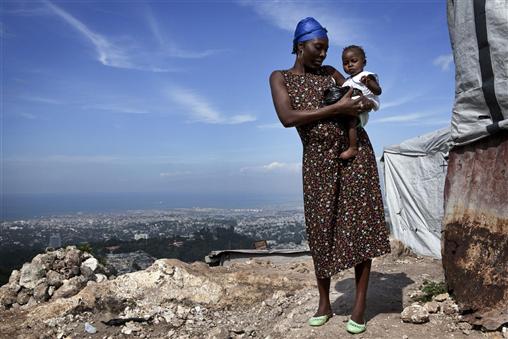
From UNICEF’s Photo of the Week: Haiti, 2011: Miscillite holds her malnourished daughter, Jeanne-Baptiste, outside their makeshift shelter in Port-au-Prince. They live in a camp for people displaced by the January 2010 earthquake. Miscillite, who has four children and is pregnant, struggles to feed her family. Jeanne-Baptiste receives therapeutic food at a nearby UNICEF-supported community clinic.
A friend asked me tonight to give an overview of my field – public health. Of course, I could not do that. First, I am fairly new to public health, after working in marketing for two years and completing my master’s degree. Second, the field is way too broad and figuring out an entry point definitely depends on what you do within public health. And for me, this is health communication. So, I will share below part of the conversation we had, which is basically me trying to explain the role of social marketing and health communication within the wider public health agenda:
“I entered the field of public health through my education and experience in marketing and communication. I wanted to transfer my background to addressing social and public health issues. Health communication and social marketing is relatively new when compared to other public health areas. The American public health association included health communication within its auspices only within the last 20 years… and a document called “healthy people 2010″ developed in the early 1990′s to guide public health policies in the US included health communication on its agenda for the first time…With the release of healthy people 2020, the focus is now on getting Americans access to information in an equitable way as well as in access to accurate and timely health information
“A textbook definition for health communication is: The art and technique of informing, influencing, and motivating individual, institutional, and public audiences about important health issues. Similarly, social marketing applies the rules and principles of traditional marketing to achieve specific behavioral (or social) goals
“Essentially, many of what we do is an attempt to either change high risk behaviors (as in the case of HIV and STDs) or get people to adopt healthy or prosocial behaviors
“People who work within this fields so a range of things. many focus on designing public health campaigns for television, radio, print, the internet, etc
“My interest in communication includes the use of mass media (radio, tv, internet) to promote healthy behaviors…but I am also interested in what’s called “health information seeking behaviors” and that is how, what, when, why etc people seek out health information and how we can use that knowledge to advance prevention messages and interventions
“For example, a lot of research in this country is done on information seeking as it relates to cancer. Not much is known about HIV/STD information-seeking behavior. This is a major barrier if you are trying to do a communication-based project addressing HIV and the like
“There is another angle to health communication with active research and practice: patient-provider communication. This area deals directly with the medical professions in that much of the research takes place in medical settings and seek to address how those professionals interact with their patients.”
I realize now that my answer only touched the tip of the iceberg for the field…
News of children being bought and sold is heartbreaking because there are little to no protections for children or parents in these situations. Time and time, we hear of parents giving up their kids, hoping they’ll get a chance a at a better life. And, time and time again we read reports of how many Haitian children are sold like commodities, or put into the slave trade. Despite all the reports, it is upsetting to learn that Haiti has no law against trafficking on children. Let’s hope that while they rebuild structurally, the leaders of this great nation will consider building laws that so that their precious jewels will be saved from this ungodly future.
I think it’s the the region starts approaching violence prevention as a public health issue, and not just a law enforcement or social justice one. In categorizing it as such, it affords the opportunity to define the problem beyond deviance and to seek the underlying issues facilitating such behavior. For indeed, many of these issues are behavioral in nature. Having lived in the Virgin Islands and experiences first-hand the effects of crime and violence on my family, I know there are serious causes affecting the crime rate and demonizing those involved in violence has not been getting us far.
I have also seen the rise in news stories from across the region on crime rates. Today, it is the Bahamas. Tomorrow, it will be another island discussing the rising crime rate. There are several recourses that local leaders can access if they want to reframe the problem. First, the WHO publication Violence – a public health problem, defines violence within the context of public health and offers ways to address the issue, saying, “The public health approach to any problem is interdisciplinary and science-based.” And, “The public health approach also emphasizes collective action.” One of the reasons I gravitated to public health was its focus on prevention and interventions. Within these areas, Caribbean communities can design multi-faceted, locally and culturally-relevant responses to violence. It begins with understanding your society and community and understanding the impact of violence on the health of people.
The Center’s for Disease Control also has excellent resources on various types of violence and public health approaches to violence prevention. Beyond violent crime, they address sexual violence, intimate partner violence, youth violence and more. Close to home, they can also draw on resources from PAHO Violence and Injury Prevention unit.
Haiti stopped its participation in the tournament, currently being held in Jamaica, after three players fell sick to malaria. “Yes, it is true, medical tests have confirmed that the players are suffering from malaria,” said Haiti’s coach, Wilner Etienne. This is definitely another blow for the country. We have seen many times how sports can lift the spirits of many a nations. I wish all the young players well and a full recovery. And, hope they get another chance to participate in the region-wide tournament.

 Caribbean Health Communication Blog